
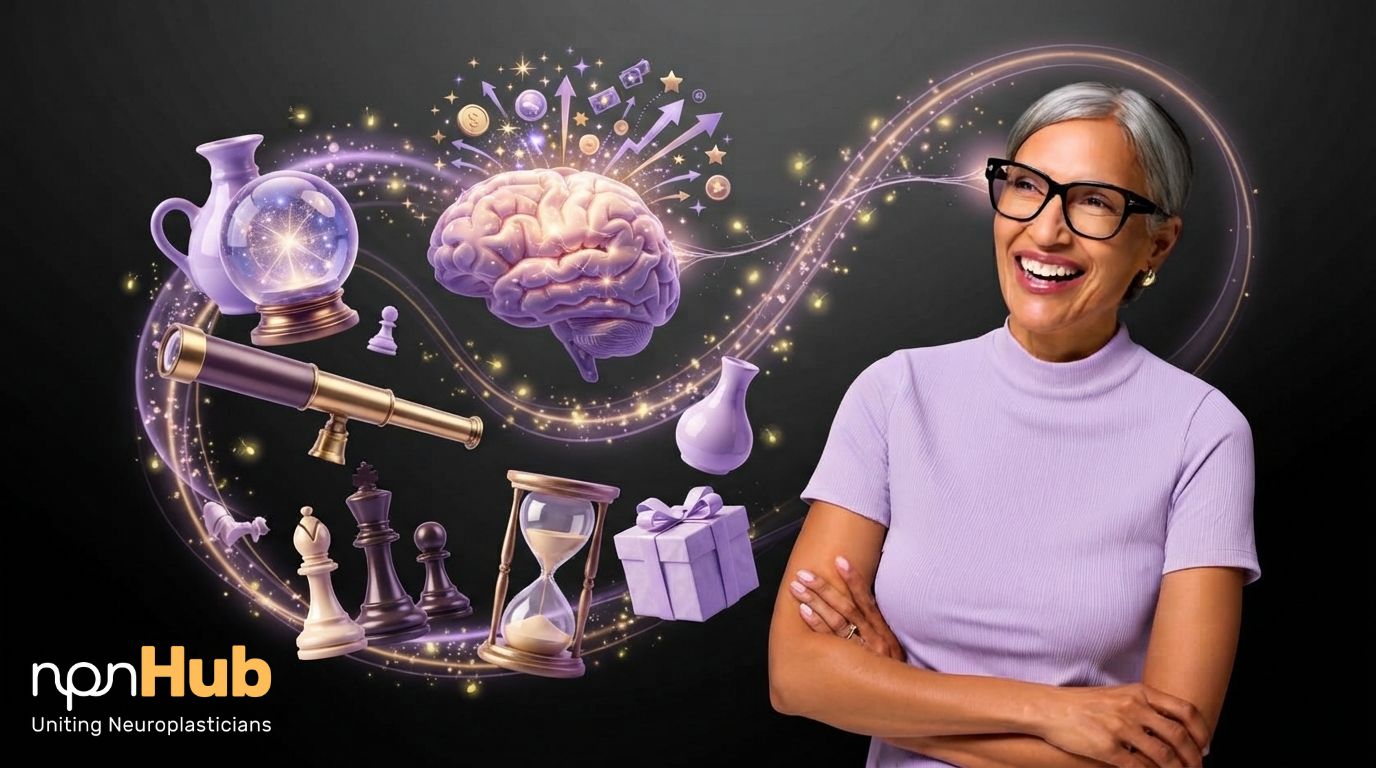
How dopamine, cues, prediction errors, motivation, and learned expectations shape behavior before conscious choice begins
npnHub Editorial Member: Greg Pitcher curated this blog
Key Points
- The brain often predicts rewards before action by using learned cues, memories, emotions, and past outcomes.
- Dopamine is deeply involved in reward prediction, motivation, learning, wanting, and updating behavior when outcomes differ from expectation.
- Reward prediction helps the brain prepare action before the reward appears.
- Brain regions involved include the ventral tegmental area, nucleus accumbens, striatum, prefrontal cortex, orbitofrontal cortex, amygdala, hippocampus, and basal ganglia.
- Modern environments can train the brain to anticipate rewards from notifications, food cues, social approval, shopping, gaming, and digital novelty.
- Practitioners can help clients reshape reward prediction loops through cue awareness, pause practices, values-based reward, and prediction updating.
1. What Does It Mean That Your Brain Predicts Rewards Before You Even Act?
Imagine a wellbeing practitioner working with a client who says, “I reach for my phone before I even think about it.” The client is not exaggerating. The hand moves almost automatically after a notification sound, a moment of boredom, or a flicker of anxiety. The practitioner explains, “Your brain may already be predicting a reward before you consciously decide to check.”
This is an illustrative example, not a scientific case.
The brain predicts rewards by learning from cues. A cue is anything that signals a possible outcome: a smell from a bakery, a message alert, a calendar reminder, a familiar person’s tone, a shop window, or the first line of an email. Once the brain has learned that a cue may lead to reward, relief, status, pleasure, safety, or novelty, it begins preparing before the reward arrives.
This predictive system is efficient. It helps people act quickly, pursue goals, and learn from experience. But it can also make behavior feel automatic. The brain does not wait for full conscious analysis every time. It uses past learning to estimate what might happen next.
Schultz, Dayan, and Montague showed that dopamine neurons are involved in prediction and reward learning, with responses shifting toward cues that predict reward (Schultz et al., 1997). Schultz later described dopamine reward prediction error signals as helping the brain learn when rewards are better, worse, or exactly as expected (Schultz, 2016).
For practitioners, this means behavior change must address what happens before the action. The brain may already be preparing to act at the cue stage.
2. The Neuroscience of Reward Prediction
Imagine a neuroscience educator teaching coaches about motivation. She places a sealed envelope on a table and says, “There may be good news inside.” No one has opened it yet, but attention changes. Curiosity rises. Bodies lean forward. The reward has not arrived. The prediction has.
This is an illustrative example, not a scientific reference.
Reward prediction involves several interacting brain systems. Dopamine neurons in the ventral tegmental area and substantia nigra send signals to the nucleus accumbens, dorsal striatum, prefrontal cortex, amygdala, and hippocampus. These circuits help the brain learn which cues matter, what actions are worth taking, and how outcomes compare with expectations.
One important concept is reward prediction error. If an outcome is better than expected, dopamine activity may increase. If the outcome is exactly as expected, the signal may be smaller. If an expected reward does not appear, dopamine activity may decrease. This helps the brain update future predictions.
Schultz describes dopamine neurons as coding reward prediction errors in ways that resemble teaching signals used in learning models (Schultz, 2016). O’Doherty and colleagues found dissociable roles for ventral and dorsal striatum in instrumental conditioning, with ventral striatum involved in learning and dorsal striatum involved in performance (O’Doherty et al., 2004).
The amygdala helps assign emotional salience to cues. The hippocampus adds memory and context. The orbitofrontal cortex helps evaluate expected value. The prefrontal cortex supports planning, inhibition, and goal alignment. The basal ganglia help convert reward predictions into action patterns.
The main brain areas affected include the ventral tegmental area, substantia nigra, nucleus accumbens, ventral striatum, dorsal striatum, prefrontal cortex, orbitofrontal cortex, amygdala, hippocampus, anterior cingulate cortex, and basal ganglia.
3. What Neuroscience Practitioners, Neuroplasticians and Well-being Professionals Should Know About Reward Prediction
A coach may work with a client who says, “I know I should not open the app, but it feels like I have already started before I notice.” This is where reward prediction becomes practical. The client may be entering the behavior not at the moment of action, but at the moment the brain detects a cue and predicts relief, novelty, or reward.
This is an illustrative example, not a scientific case.
Professionals should know that many habits begin before the visible behavior. A client may eat before hunger is clear because the brain predicts comfort. They may check email because the brain predicts relief from uncertainty. They may procrastinate because the brain predicts escape from discomfort. They may overwork because the brain predicts approval, safety, or worth.
A common myth is that reward prediction is only about pleasure. In reality, the brain may predict relief, reduced anxiety, belonging, control, or avoidance of pain. Another myth is that dopamine equals happiness. Dopamine is more closely involved in motivation, learning, wanting, and prediction than simple pleasure.
Professionals often encounter questions such as:
- Why do clients act before they feel consciously ready?
- Why do certain cues trigger powerful urges?
- How can clients update reward predictions that no longer serve them?
Berridge and Robinson argue that dopamine is especially involved in incentive salience, or “wanting,” rather than pure pleasure or “liking” (Berridge & Robinson, 1998). This helps explain why a client may strongly want something that does not deeply satisfy them.
For practitioners, the useful question is not only “What did the client do?” It is “What did the brain predict the action would provide?”
4. How Reward Prediction Affects Neuroplasticity
Reward prediction affects neuroplasticity because the brain strengthens pathways that seem useful, rewarding, relieving, or important. When a cue appears, the brain predicts an outcome. If the action brings reward or relief, the pathway becomes more likely to repeat. If the outcome violates the prediction, the brain has a chance to update.
This is how habits form. A person feels stressed. The phone is nearby. The brain predicts distraction or relief. The person checks. Stress reduces for a moment. The brain learns: stress plus phone equals relief. With repetition, the cue-action-reward pathway becomes faster.
Reward prediction can support healthy neuroplasticity too. A client who repeatedly experiences satisfaction after exercise may begin to anticipate the reward of movement. A learner who experiences progress after practice may begin to feel motivated before practicing. A client who feels calmer after naming an emotion may begin predicting regulation instead of overwhelm.
The challenge is that short-term rewards can overpower long-term wellbeing. Fast relief may train the brain more quickly than slow growth. That is why modern reward cues can shape neuroplasticity so strongly. Notifications, processed foods, shopping prompts, and social feedback often provide quick prediction loops.
Volkow, Wise, and Baler describe dopamine as part of a broader motive system involved in reinforcement, motivation, and self-regulation, with implications for addictive patterns around drugs and food (Volkow et al., 2017). Kauer and Malenka describe how reward-related plasticity can become deeply embedded in mesolimbic dopamine circuits in addiction (Kauer & Malenka, 2007).
For neuroplasticity practitioners, the goal is not to remove reward. It is to help the brain predict better rewards from healthier pathways.
5. Neuroscience-Backed Interventions to Reshape Reward Prediction
Behavioral interventions matter because reward prediction happens before action. The main challenge is that clients often try to change the behavior after the cue has already activated the pathway. Practitioners can help clients intervene earlier by identifying cues, naming predicted rewards, testing expectations, and attaching motivation to values-based outcomes.
1. The Cue Prediction Map
Concept: Dopamine responses can shift toward cues that predict reward. Schultz, Dayan, and Montague showed that dopamine neurons are involved in prediction and reward learning (Schultz et al., 1997).
Example: A practitioner works with a client who checks their phone whenever work feels difficult. Instead of focusing only on the checking, they identify the earlier cue: discomfort at the first sign of mental effort.
Intervention:
- Ask the client to choose one repeated behavior.
- Identify the cue that appears before the action.
- Ask, “What does my brain predict this action will give me?”
- Write the predicted reward: relief, novelty, control, approval, escape, comfort, or pleasure.
- Track whether the predicted reward actually happens.
2. The Wanting Versus Reward Check
Concept: Dopamine is strongly linked with incentive salience, or wanting, rather than pure pleasure. Berridge and Robinson explain that wanting and liking can become separated (Berridge & Robinson, 1998).
Example: A coach supports a client who feels pulled toward late-night snacking. The client rates wanting before eating as high, but satisfaction afterward as low.
Intervention:
- Ask the client to rate wanting before the behavior from 1 to 10.
- Ask them to rate satisfaction after the behavior from 1 to 10.
- Compare the prediction with the outcome.
- Discuss whether the behavior delivers what the brain expected.
- Choose one alternative reward that is more genuinely restorative.
3. The Prediction Error Update
Concept: Reward prediction error helps the brain update learning when outcomes are better or worse than expected. Schultz describes dopamine prediction error coding as a teaching signal for future behavior (Schultz, 2016).
Example: A wellbeing professional works with a client who believes exercise will feel awful. They agree to a short walk. Afterward, the client notices a slight improvement in mood. The practitioner highlights the prediction error: the outcome was better than expected.
Intervention:
- Ask the client to predict how a healthy action will feel.
- Complete a small version of the action.
- Compare the prediction with the real outcome.
- Name any positive surprise, relief, or competence.
- Repeat so the brain updates future expectations.
4. The Values-Based Reward Replacement
Concept: Dopamine systems support motivation and reinforcement. Volkow, Wise, and Baler describe dopamine as part of a motive system that shapes reinforcement, motivation, and self-regulation (Volkow et al., 2017).
Example: A neuroplastician works with a client who scrolls for stimulation but wants more creativity. Instead of only removing the phone, they create a small creative reward loop.
Intervention:
- Identify one value the client wants to strengthen.
- Choose one small action linked to that value.
- Add an immediate reward after completion.
- Make progress visible.
- Repeat until the brain begins predicting reward from meaningful effort.
5. The Pause Before Pursuit
Concept: The prefrontal cortex helps regulate goal-directed behavior, while reward systems can prepare action quickly when cues predict reward. O’Doherty and colleagues’ findings on striatal roles in instrumental conditioning help show how learning and performance systems can support cue-action patterns (O’Doherty et al., 2004).
Example: An educator supports a client who buys items online whenever they feel underappreciated. The practitioner helps insert a pause between cue and action.
Intervention:
- Ask the client to pause for two minutes before acting on the cue.
- Name the predicted reward.
- Ask whether the action matches the client’s values.
- Choose to continue, delay, reduce, or replace the behavior.
- Reflect afterward without shame.
6. Key Takeaways
Your brain predicts rewards before you act because it is designed to learn from cues and outcomes. This system helps you pursue goals, avoid wasted effort, and adapt to the world. But it can also make habits feel automatic when the brain predicts relief, novelty, approval, or pleasure before conscious choice begins.
For practitioners, reward prediction is a powerful intervention point. Instead of focusing only on behavior, help clients notice the cue, name the predicted reward, compare prediction with reality, and teach the brain better expectations through repeated experience.
- Reward prediction begins at the cue stage, before the visible action.
- Dopamine helps the brain learn from reward prediction errors.
- Wanting and liking are not the same.
- The striatum, prefrontal cortex, amygdala, hippocampus, and dopamine systems help turn predictions into action.
- Modern life can train the brain to expect reward from fast cues.
- Practitioners can reshape behavior by helping clients update predictions and build healthier reward loops.
7. References
- Berridge, K. C., & Robinson, T. E. (1998). What is the role of dopamine in reward: Hedonic impact, reward learning, or incentive salience? Brain Research Reviews, 28(3), 309–369. https://pubmed.ncbi.nlm.nih.gov/9858756/
- Kauer, J. A., & Malenka, R. C. (2007). Synaptic plasticity and addiction. Nature Reviews Neuroscience, 8(11), 844–858. https://pubmed.ncbi.nlm.nih.gov/17948030/
- O’Doherty, J., Dayan, P., Schultz, J., Deichmann, R., Friston, K., & Dolan, R. J. (2004). Dissociable roles of ventral and dorsal striatum in instrumental conditioning. Science, 304(5669), 452–454. https://pubmed.ncbi.nlm.nih.gov/15087550/
- Schultz, W. (2016). Dopamine reward prediction error coding. Dialogues in Clinical Neuroscience, 18(1), 23–32. https://pubmed.ncbi.nlm.nih.gov/27069377/
- Schultz, W., Dayan, P., & Montague, P. R. (1997). A neural substrate of prediction and reward. Science, 275(5306), 1593–1599. https://pubmed.ncbi.nlm.nih.gov/9054347/
- Volkow, N. D., Wise, R. A., & Baler, R. (2017). The dopamine motive system: Implications for drug and food addiction. Nature Reviews Neuroscience, 18(12), 741–752. https://pubmed.ncbi.nlm.nih.gov/29142296/