
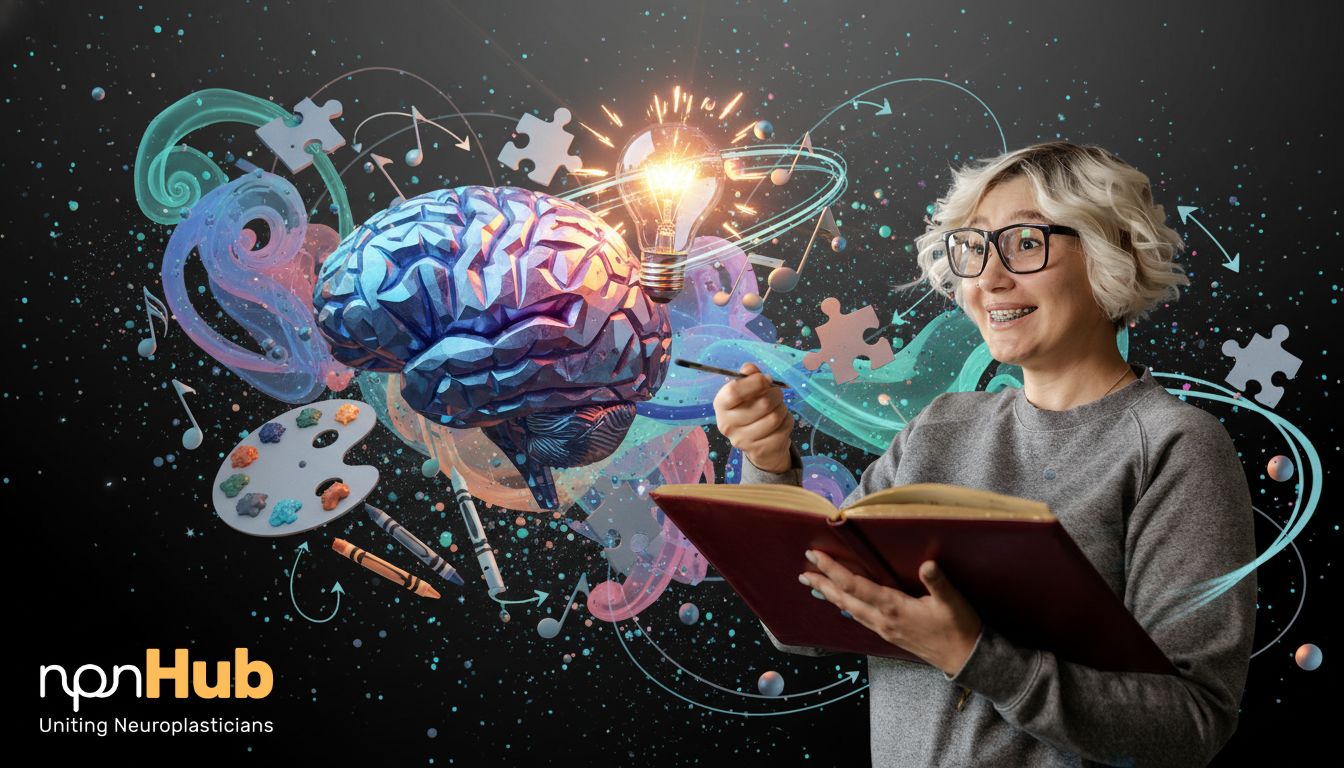
Unlocking the Neuroscience of Creativity for Faster Thinking, Innovation, and Problem-Solving
npnHub Editorial Member: Willem Royaards curated this blog
Key Points
- Creativity is driven by dynamic interaction between brain networks
- Dopamine plays a key role in idea generation and motivation
- The default mode network supports spontaneous and creative thinking
- Simple behavioral shifts can rapidly enhance creative output
- Neuroplasticity strengthens creative thinking with repeated practice
1. What are Brain Hacks That Spark Instant Creativity?
Imagine a creativity coach working with a client who feels stuck on a major project. The client stares at the same problem for hours, unable to generate new ideas. Then, after stepping away for a short walk, a breakthrough suddenly appears.
This is an illustrative example, not a scientific case.
Creativity often feels unpredictable, but neuroscience shows it follows identifiable brain patterns. What we call a “creative spark” is the result of shifts in neural activity, particularly between focused and diffuse thinking modes.
Research by Dr. Roger Beaty at Penn State University highlights how creativity emerges from the interaction between brain networks rather than a single “creative center” (Beaty et al.).
These “brain hacks” are simple, science-backed strategies that shift neural states quickly, allowing individuals to access new ideas, perspectives, and solutions. Rather than waiting for inspiration, creativity can be intentionally activated.
2. The Neuroscience of Brain Hacks That Spark Instant Creativity
Consider a neuroscience practitioner observing a client during a problem-solving task. When the client is intensely focused, ideas are limited. But when the client relaxes and allows the mind to wander, novel connections begin to form.
This is an illustrative example.
Creativity depends on the interaction between three key brain networks. The default mode network (DMN) generates spontaneous ideas and internal thoughts. The executive control network (ECN) evaluates and refines these ideas. The salience network switches between the two.
Dr. Marcus Raichle, who identified the DMN, showed that this network becomes active during rest and mind-wandering, enabling creative insight (Raichle et al.).
Dopamine plays a crucial role by enhancing motivation and reinforcing novel thinking patterns. Increased dopamine levels are associated with greater cognitive flexibility and idea generation.
Key brain areas involved include:
The prefrontal cortex for idea evaluation
The default mode network for idea generation
The anterior cingulate cortex for switching attention
In essence, creativity emerges when the brain balances structure with spontaneity.
3. What Neuroscience Practitioners, Neuroplasticians and Well-being Professionals Should Know About Brain Hacks That Spark Instant Creativity
A wellbeing professional once worked with a team that believed creativity was a fixed trait. Some members identified as “creative,” while others did not. Through targeted interventions, the practitioner demonstrated that creativity could be activated in anyone by shifting mental states.
This is an illustrative example.
A common myth is that creativity is a talent reserved for a few. In reality, neuroscience shows that everyone has the neural architecture for creativity. The difference lies in how effectively individuals engage their brain networks.
Another misconception is that creativity requires constant focus. In fact, excessive focus can suppress creative thinking by limiting the brain’s ability to form novel connections.
Research from Stanford University shows that walking increases creative output by up to 60 percent (Oppezzo & Schwartz).
Professionals often encounter questions such as:
- How can I help clients access creativity on demand?
- Why do some clients feel blocked despite high intelligence?
- Can creativity be trained like a skill?
Understanding these dynamics allows practitioners to design environments that naturally stimulate creative thinking.
4. How Brain Hacks That Spark Instant Creativity Affect Neuroplasticity
Creativity is not just a momentary experience. It is a trainable brain function shaped by neuroplasticity. Each time an individual engages in creative thinking, neural pathways associated with idea generation and cognitive flexibility are strengthened.
Repeated activation of the default mode network and executive control network improves their coordination over time. This makes it easier to switch between generating ideas and evaluating them effectively.
Research by Draganski et al. demonstrated that learning new skills leads to structural brain changes, reinforcing the principle that repeated mental activity reshapes neural architecture (Draganski et al., 2004).
Importantly, the brain strengthens whatever is practiced. Regular engagement in creative tasks builds stronger neural networks for innovation, while rigid thinking patterns reinforce limitation.
Over time, these “instant” brain hacks become long-term cognitive advantages, enhancing adaptability, problem-solving, and original thinking.
5. Neuroscience-Backed Interventions to Improve Brain Hacks That Spark Instant Creativity
Behavioral interventions matter because many clients struggle with creative blocks, not due to lack of ability, but due to inefficient brain states. A neuroscience coach may work with a client who is overthinking, preventing access to creative insight.
1. Strategic Mind-Wandering
Concept: The default mode network activates during rest, supporting idea generation (Raichle et al.)
Example: A coach encourages a client to step away from a problem to allow new ideas to emerge
Intervention:
- Schedule short breaks during deep work
- Engage in low-effort activities like walking
- Avoid screens during these breaks
- Capture ideas immediately after
2. Movement-Based Creativity Boost
Concept: Physical movement increases cognitive flexibility and creative output (Oppezzo & Schwartz)
Example: A practitioner integrates walking sessions into creative coaching
Intervention:
- Encourage walking meetings
- Use movement before brainstorming sessions
- Combine physical activity with idea generation
- Track creative output after movement
3. Dopamine Activation Through Novelty
Concept: Novel experiences increase dopamine, enhancing creativity (Schultz, 1997)
Example: A coach introduces new environments to stimulate fresh thinking
Intervention:
- Change work environments regularly
- Introduce new sensory inputs
- Try unfamiliar activities
- Use novelty before creative tasks
4. Constraint-Based Thinking
Concept: Constraints activate the prefrontal cortex, improving problem-solving (Stokes, 2005)
Example: A practitioner limits options to help a client generate focused ideas
Intervention:
- Set specific limits for brainstorming
- Use time constraints
- Focus on solving one problem at a time
- Reframe constraints as opportunities
5. Rapid Idea Generation (Divergent Thinking)
Concept: Generating multiple ideas increases creative output (Beaty et al.)
Example: A coach guides a client to produce many ideas without judgment
Intervention:
- Set a timer for idea generation
- Avoid evaluating ideas initially
- Aim for quantity over quality
- Review and refine afterward
6. Key Takeaways
Creativity is not a mysterious talent. It is a brain function that can be activated, trained, and strengthened. By understanding how the brain generates and evaluates ideas, practitioners can help clients move from creative blocks to consistent innovation.
The key is not to force creativity, but to create the right neural conditions for it to emerge.
- Creativity is driven by interacting brain networks
- Brain states can be shifted quickly with simple strategies
- Repetition strengthens creative neural pathways
- Anyone can develop creativity with the right approach
7. References
- Beaty, R. E. et al. (2018). Robust prediction of individual creative ability. PNAS. https://www.pnas.org/doi/10.1073/pnas.1713532115
- Raichle, M. E. et al. (2001). A default mode of brain function. PNAS. https://www.pnas.org/doi/10.1073/pnas.98.2.676
- Oppezzo, M., & Schwartz, D. (2014). Give your ideas some legs: the positive effect of walking on creative thinking. APA Monitor. https://pubmed.ncbi.nlm.nih.gov/24749966/
- Draganski, B. et al. (2004). Changes in grey matter induced by training. Nature. https://www.nature.com/articles/427311a
- Schultz, W. (1997). Dopamine neurons and reward. Journal of Neurophysiology. https://www.ncbi.nlm.nih.gov/pTubmed/9054347
- Stokes, P. D. (2005). Creativity from constraints. American Psychological Association. https://books.google.co.za/books?id=XkkmQo10ZVgC&pg=PA1&source=gbs_toc_r&cad=2#v=onepage&q&f=false