
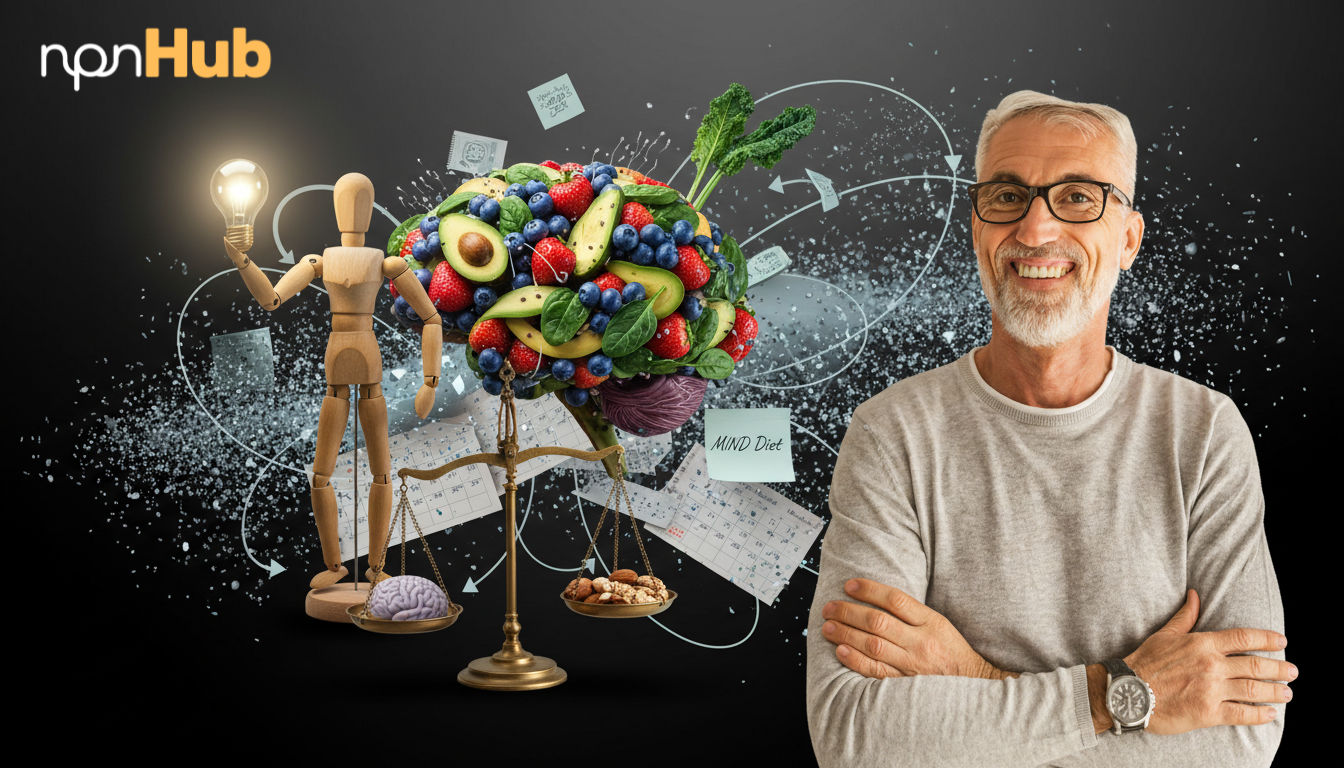
The neuroscience behind the MIND diet and how targeted nutrition protects memory, slows cognitive decline, and enhances neuroplasticity
npnHub Editorial Member: Dr. Justin Kennedy curated this blog
Key Points
- The MIND diet combines Mediterranean and DASH principles to reduce dementia risk.
- Research shows high adherence to the MIND diet can slow brain aging by up to 7.5 years.
- Key nutrients in leafy greens, berries, and healthy fats protect the hippocampus and prefrontal cortex.
- The diet reduces inflammation, oxidative stress, and beta amyloid accumulation.
- Neuroscience practitioners can integrate MIND diet principles into cognitive longevity programs.
- Nutrition directly influences neuroplasticity, synaptic function, and brain-derived neurotrophic factor.
1. What is the MIND Diet?
A cognitive wellness coach once worked with a 62-year-old executive who feared developing Alzheimer’s like her mother. She exercised. She meditated. But her diet was inconsistent. The coach introduced a simple framework: the MIND diet. Within months, not only did her energy improve, but she felt sharper, more focused, and less anxious about her future.
This illustrative example reflects a growing scientific truth: food is brain architecture.
The MIND diet, short for Mediterranean DASH Intervention for Neurodegenerative Delay, was developed by Dr. Martha Clare Morris and colleagues at Rush University Medical Center. It blends elements of the Mediterranean diet and the DASH diet but targets specific foods shown to protect cognitive function.
In a landmark study, high adherence to the MIND diet was associated with a 53% reduction in Alzheimer’s risk, and even moderate adherence reduced risk by 35% (Morris et al., 2015).
Even more compelling, those who closely followed the MIND diet showed cognitive performance equivalent to being 7.5 years younger (Morris et al., 2015).
This is not a fad diet. It is a neuroprotective blueprint.
2. The Neuroscience of the MIND Diet
During a brain health seminar, a practitioner showed side-by-side brain scans of individuals with inflammatory diets versus those following Mediterranean-style patterns. The differences in hippocampal volume were striking.
Again, this is an illustrative scenario – but the underlying neuroscience is well documented.
The MIND diet works by targeting three core mechanisms of brain aging:
1. Reducing Neuroinflammation
Chronic inflammation damages neurons and accelerates cognitive decline. Foods rich in antioxidants – like berries and leafy greens – neutralize free radicals and reduce inflammatory cytokines.
2. Supporting Synaptic Plasticity
Omega-3 fatty acids from fish and olive oil increase synaptic membrane fluidity and improve neural signaling.
3. Protecting Against Amyloid Accumulation
Polyphenols found in berries and green vegetables may reduce beta-amyloid plaque formation, a hallmark of Alzheimer’s pathology.
Research published in Alzheimer’s & Dementia found that adherence to the MIND diet correlated with slower cognitive decline over nearly five years (Morris et al., 2015).
Brain regions most impacted include:
- Hippocampus (memory formation)
- Prefrontal cortex (decision-making and executive function)
- Temporal lobes (language and recall)
The diet literally feeds neuroplasticity.
3. What Neuroscience Practitioners and Well-being Professionals Should Know About the MIND Diet
A neuroplastician working with aging clients once noticed something surprising: those who changed their nutrition patterns often experienced cognitive improvements faster than those relying on cognitive exercises alone.
This story is illustrative, but it mirrors clinical experience.
Professionals must understand that:
- Cognitive decline is not just neurological – it is metabolic.
- The brain consumes about 20% of the body’s energy.
- Insulin resistance and vascular dysfunction directly affect memory circuits.
Common myths practitioners encounter:
- Myth: Supplements can replace diet.
Fact: Whole foods provide synergistic nutrient combinations that supplements cannot replicate. - Myth: It’s too late to change diet after 60.
Fact: Research shows benefits even in later life stages. - Myth: Brain health is genetically predetermined.
Fact: Lifestyle factors significantly modify risk.
Frequently asked questions practitioners hear:
- Can the MIND diet reverse early cognitive decline?
- How strict does adherence need to be?
- Does it work for people with genetic risk factors like APOE4?
Studies suggest that even moderate adherence provides measurable cognitive benefits (Morris et al., 2015).
For practitioners, this means diet is not secondary – it is foundational.
4. How the MIND Diet Affects Neuroplasticity
Neuroplasticity depends on synaptic growth, dendritic branching, and neurogenesis. The MIND diet supports these processes at a cellular level.
Leafy greens provide folate, which supports methylation and neurotransmitter production.
Berries supply anthocyanins, which cross the blood-brain barrier and enhance neuronal signaling.
Healthy fats from olive oil and nuts reduce oxidative stress and improve membrane function.
Animal and human studies show that omega-3 fatty acids increase BDNF (Brain-Derived Neurotrophic Factor) – the molecule essential for synaptic plasticity.
Over time, consistent dietary patterns either reinforce healthy neural networks or accelerate degeneration.
The MIND diet creates a biochemical environment that favors growth over decline.
5. Neuroscience-Backed Interventions to Implement the MIND Diet
Why Behavioral Nutrition Interventions Matter
Clients often know they “should eat healthier,” but they lack neurological framing. When practitioners explain that food directly influences hippocampal volume and synaptic strength, adherence improves dramatically.
Below are actionable strategies for practitioners.
1. Prioritize Leafy Greens Daily
Concept: One serving of leafy greens per day is associated with slower cognitive decline equivalent to being 11 years younger ( Morris et al., 2018).
Example: A coach integrates a “daily greens challenge” into a cognitive longevity program.
Intervention:
- Add spinach, kale, or arugula to one meal daily.
- Use smoothies if chewing fatigue is an issue.
- Track mood and focus changes weekly.
2. Add Berries Twice Per Week
Concept: Berries improve memory through antioxidant and anti-inflammatory effects (Devore et al., 2012).
Example: A practitioner encourages older clients to replace dessert with blueberries.
Intervention:
- ½ cup blueberries or strawberries at least twice weekly.
- Pair with yogurt for protein balance.
- Educate clients on anthocyanin benefits.
3. Replace Butter with Olive Oil
Concept: Monounsaturated fats improve vascular function and reduce inflammation (Martínez-Lapiscina et al., 2013).
Example: A neuroeducator guides clients to cook exclusively with extra virgin olive oil.
Intervention:
- Eliminate margarine and trans fats.
- Use olive oil as primary cooking fat.
- Teach label reading skills.
4. Increase Fish Intake Weekly
Concept: Omega-3 fatty acids support synaptic plasticity and memory circuits (Yurko-Mauro et al., 2010).
Example: A well-being coach includes a weekly “brain fish night.”
Intervention:
- Aim for 1–2 servings fatty fish weekly.
- Consider sardines or salmon.
- Track energy and clarity outcomes.
6. Key Takeaways
The MIND diet is not about restriction – it’s about protection.
Food becomes a daily neuroplastic intervention. When clients understand that leafy greens and berries may preserve hippocampal volume and reduce dementia risk, compliance shifts from obligation to empowerment.
The brain responds to what we feed it.
🔹 The MIND diet reduces Alzheimer’s risk by up to 53%.
🔹 High adherence may slow brain aging by 7.5 years.
🔹 Nutrients like omega-3s and polyphenols support neuroplasticity.
🔹 Practitioners can integrate dietary strategies into brain-based programs.
Your client’s next meal is shaping their neural future.
7. References
- Morris, M. C., Tangney, C. C., Wang, Y., et al. (2015). MIND diet associated with reduced incidence of Alzheimer’s disease. Alzheimer’s & Dementia, 11(9), 1007–1014. https://pubmed.ncbi.nlm.nih.gov/25681666/
- Morris, M. C., et al. (2018). Green leafy vegetables and cognitive decline. Neurology, 90(3), e214–e222. https://pubmed.ncbi.nlm.nih.gov/29263222/
- Devore, E. E., et al. (2012). Dietary intakes of berries and flavonoids and cognitive decline. Annals of Neurology, 72(1), 135–143.https://pubmed.ncbi.nlm.nih.gov/22535616/
- Martínez-Lapiscina, E. H., et al. (2013). Mediterranean diet improves cognition. Journal of Neurology, Neurosurgery & Psychiatry, 84(12), 1318–1325. https://pubmed.ncbi.nlm.nih.gov/23670794/
- Yurko-Mauro, K., et al. (2010). Beneficial effects of DHA on cognition. Alzheimer’s & Dementia, 6(6), 456–464. https://pubmed.ncbi.nlm.nih.gov/20434961/
8. Useful Links
- Rush University Medical Center – MIND Diet
https://www.rush.edu/news/mind-diet - Alzheimer’s Association – Brain Healthy Diet
https://www.alz.org/help-support/brain_health - National Institute on Aging – Nutrition and Brain Health
https://www.nia.nih.gov/health/brain-health - Harvard Health – Foods Linked to Better Brainpower
https://www.health.harvard.edu/healthbeat/foods-linked-to-better-brainpower