
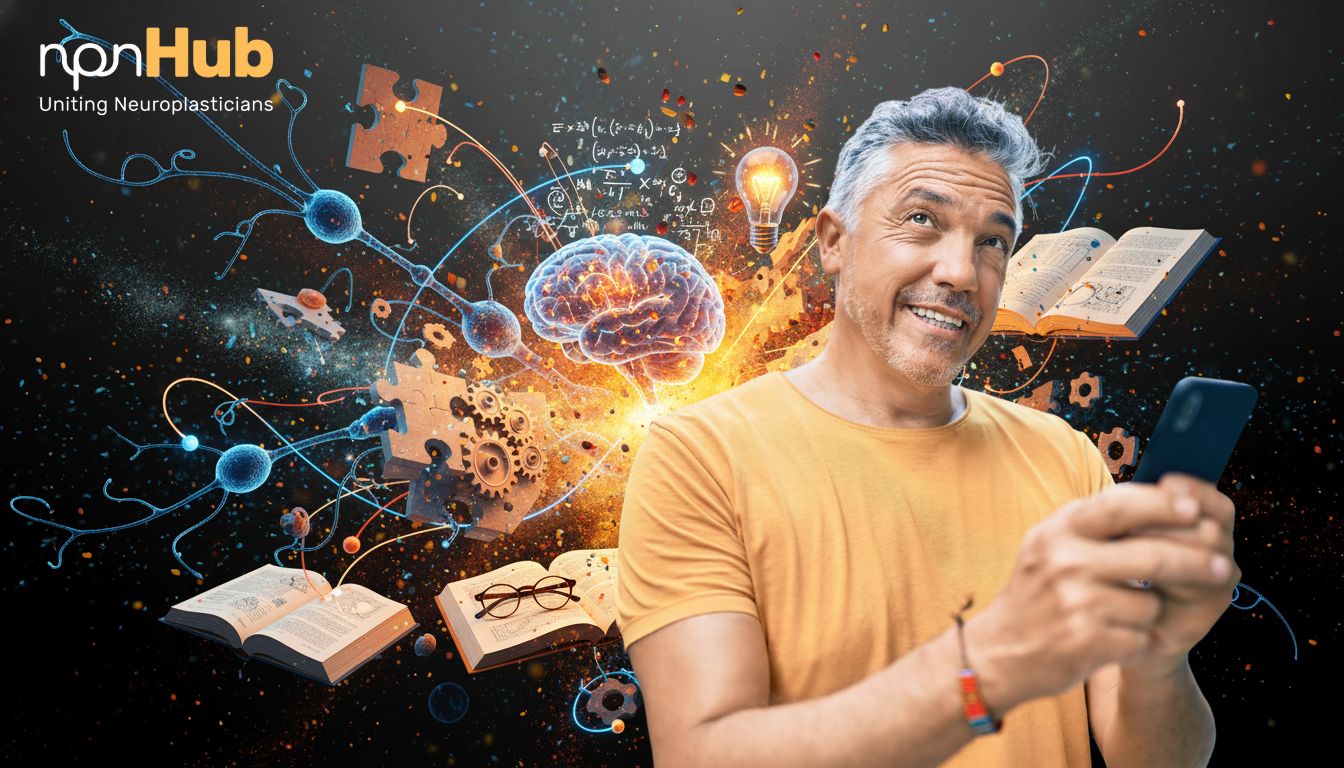
Unlocking the Brain’s Ability to Rewire, Adapt, and Master New Skills
npnHub Editorial Member: Greg Pitcher curated this blog
Key Points
- Neuroplasticity is the brain’s ability to reorganize itself through learning and experience
- Repetition and focused attention strengthen neural pathways for skill acquisition
- Dopamine and motivation reinforce learning processes (Schultz, 1997)
- The prefrontal cortex, hippocampus, and motor cortex are central to learning
- Evidence-based interventions can accelerate neuroplastic change
1. What is Neuroplasticity?
Imagine a performance coach working with a client struggling to learn a new leadership skill. At first, the client hesitates and falls back into familiar habits. But after several weeks of intentional practice, something shifts. The responses become smoother, more natural.
This is an illustrative example, not a scientific case.
What is happening is neuroplasticity – the brain’s ability to reorganize itself by forming and strengthening neural connections through experience.
Research by (Merzenich, 2013) demonstrates that the brain remains adaptable throughout life. Similarly, (Draganski et al., 2004) showed that learning new skills, such as juggling, leads to measurable increases in gray matter.
Neuroplasticity is not limited to recovery from injury. It is the biological foundation of learning, behavior change, and skill mastery.
2. The Neuroscience of Neuroplasticity
Consider an educator observing students learning a new concept. At first, their understanding is fragmented. With repetition and engagement, their responses become more accurate and integrated.
This is an illustrative example.
At the neural level, learning involves synaptic plasticity, particularly long-term potentiation, where repeated activation strengthens connections between neurons (Kandel, 2001). This reflects Hebb’s foundational principle that “neurons that fire together wire together” (Hebb, 1949).
Key brain regions include:
- The prefrontal cortex for attention and decision-making
- The hippocampus for memory formation
- The basal ganglia for habit formation
- The motor cortex for physical skills
Dopamine plays a critical role by reinforcing behaviors linked to rewards, strengthening learning pathways(Schultz, 1997).
In essence, neuroplasticity is driven by coordinated activity across brain systems shaped by repetition, attention, and reward.
3. What Neuroscience Practitioners, Neuroplasticians and Well-being Professionals Should Know About Neuroplasticity
A well-being practitioner once worked with a client who believed they were incapable of change. Despite repeated attempts, the client felt stuck. Over time, the practitioner introduced the concept of neuroplasticity, reframing the challenge as a process of rewiring rather than limitation.
This is an illustrative example.
A common misconception is that the brain becomes fixed with age. However, research shows that neuroplasticity persists throughout life (Merzenich, 2013) and is supported by clinical insights from (Harvard Health Publishing, 2020).
Another myth is that repetition alone guarantees learning. Emotional engagement and attention are essential drivers of neural change (Immordino-Yang, 2016).
Professionals often encounter questions such as:
- How long does it take to rewire neural pathways?
- Can adults learn as effectively as children?
- Why do some clients plateau despite consistent practice?
Beliefs about learning also matter. Research on growth mindset shows that expectations influence neuroplastic outcomes (Dweck, 2006).
For practitioners, the key insight is that neuroplasticity is shaped not just by repetition, but by attention, belief, and emotional relevance.
4. How Neuroplasticity Affects Learning and Skill Acquisition
Neuroplasticity works through repetition and reinforcement. Each time a behavior is practiced, neural pathways become more efficient.
Initially, the prefrontal cortex is heavily involved, requiring conscious effort. Over time, as repetition continues, control shifts toward the basal ganglia, allowing behaviors to become automatic.
This process is supported by research from (Kandel, 2001), which demonstrated that learning produces lasting changes in synaptic strength and structure.
Importantly, neuroplasticity is neutral. The brain strengthens whatever is repeated. This means both productive skills and unhelpful habits can become deeply embedded.
Studies such as (Draganski et al., 2004) confirm that consistent practice leads to structural brain changes, reinforcing learning at a biological level.
Over time, intentional and focused practice reshapes neural architecture, making skill acquisition faster and more efficient.
5. Neuroscience-Backed Interventions to Improve Neuroplasticity
Behavioral interventions matter because clients often struggle with consistency rather than knowledge. A neuroscience coach may work with a client who understands what to do but fails to apply it consistently due to weak neural reinforcement.
1. Deliberate Practice with Feedback
Concept: Deliberate practice strengthens neural pathways through structured repetition (Ericsson et al., 2007)
Example: A coach uses structured role-play to refine a client’s communication skills.
Intervention:
- Break skills into smaller components
- Provide immediate feedback
- Increase complexity gradually
2. Dopamine-Based Motivation Structuring
Concept: Dopamine reinforces learning by signaling reward and progress (Schultz, 1997)
Example: A practitioner helps a client track small achievements to maintain engagement.
Intervention:
- Set clear micro-goals
- Celebrate progress immediately
- Use visual tracking tools
3. Spaced Repetition Learning
Concept: Spacing learning enhances memory consolidation (Cepeda et al., 2006)
Example: An educator schedules review sessions over time instead of cramming.
Intervention:
- Space practice sessions strategically
- Revisit material at intervals
- Combine review with real-world application
4. Emotional Engagement and Meaning
Concept: Emotion enhances memory encoding and retention (Immordino-Yang, 2016)
Example: A coach connects learning goals to a client’s personal values.
Intervention:
- Link skills to meaningful outcomes
- Use storytelling and reflection
- Encourage emotional connection to learning
6. Key Takeaways
Neuroplasticity is the foundation of learning and skill acquisition. It explains why change is always possible and why consistent, intentional practice leads to mastery.
For practitioners, this means transformation is not about willpower alone. It is about shaping the brain through structured, meaningful experiences.
- Neuroplasticity enables lifelong learning
- Repetition strengthens neural pathways
- Emotion and motivation accelerate change
- Targeted strategies improve learning outcomes
7. References
- Cepeda, N. J., Pashler, H., Vul, E., Wixted, J. T., & Rohrer, D. (2006). Distributed practice in verbal recall tasks: A review and quantitative synthesis. Psychological Bulletin, 132(3), 354–380.https://pubmed.ncbi.nlm.nih.gov/16719566/
- Draganski, B., Gaser, C., Busch, V., Schuierer, G., Bogdahn, U., & May, A. (2004). Changes in grey matter induced by training. Nature, 427, 311–312. https://www.nature.com/articles/427311a
- Dweck, C. S. (2006). Mindset: The new psychology of success. Random House.https://psycnet.apa.org/record/2006-08575-000
- Ericsson, K. A., Krampe, R. T., & Tesch-Römer, C. (2007). The role of deliberate practice in the acquisition of expert performance. Harvard Business Review https://graphics8.nytimes.com/images/blogs/freakonomics/pdf/DeliberatePractice(PsychologicalReview).pdf
- Harvard Health Publishing. (2020). What is neuroplasticity? https://www.health.harvard.edu/mind-and-mood/tips-to-leverage-neuroplasticity-to-maintain-cognitive-fitness-as-you-age
- Hebb, D. O. (1949). The organization of behavior. Wiley.https://pure.mpg.de/rest/items/item_2346268_3/component/file_2346267/content
- Immordino-Yang, M. H. (2016). Emotions, learning, and the brain. https://psycnet.apa.org/record/2014-37480-000
- Kandel, E. R. (2001). The molecular biology of memory storage. Science. https://pubmed.ncbi.nlm.nih.gov/11691980/
- Merzenich, M. M. (2013). Soft-wired: How the new science of brain plasticity can change your life. MIT Press. https://cdn.bookey.app/files/pdf/book/en/soft-wired.pdf
- Schultz, W. (1997). Dopamine neurons and reward. Journal of Neurophysiology. https://www.ncbi.nlm.nih.gov/pubmed/9054347