
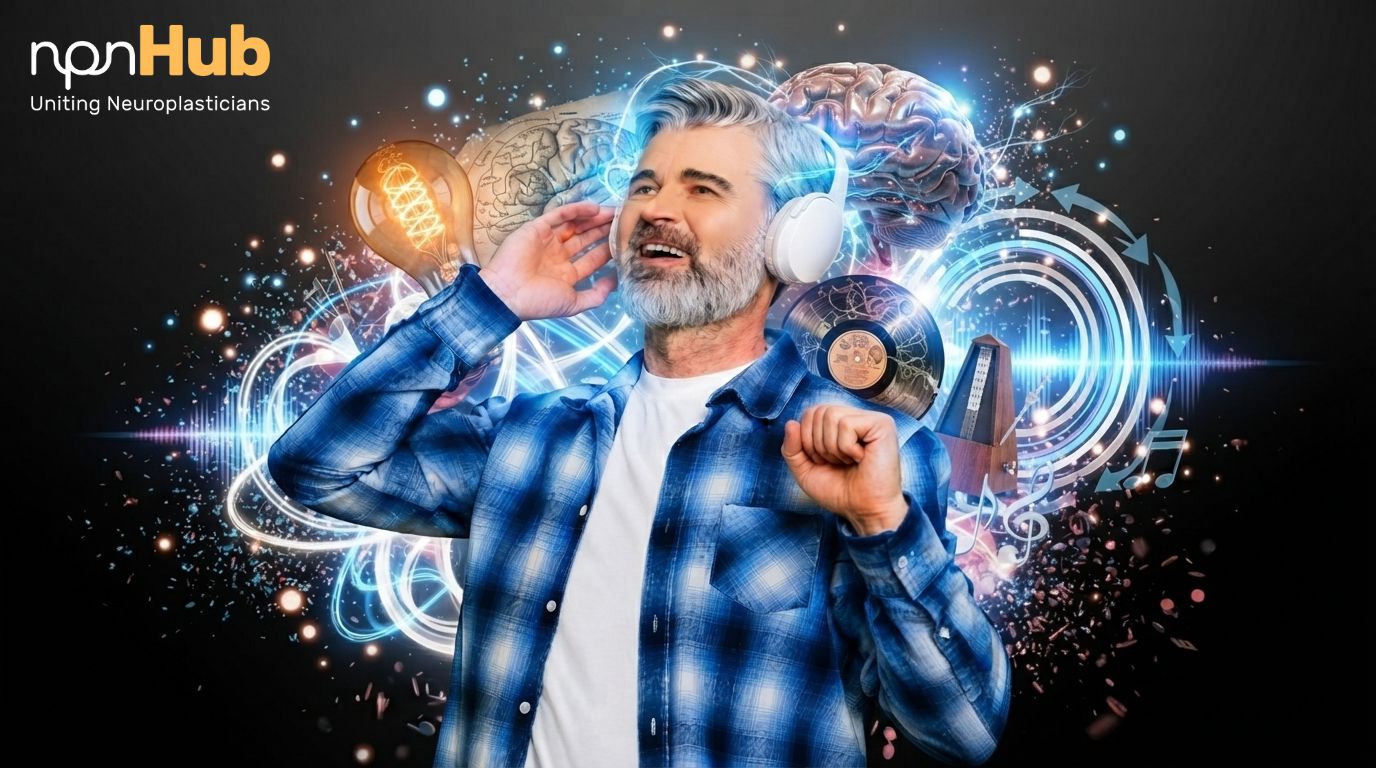
How rhythm, repetition, timing, and auditory-motor entrainment shape learning, movement, attention, and neuroplasticity
npnHub Editorial Member: Willem Royaards curated this blog
Key Points
- Rhythm can help the brain organize movement, attention, prediction, memory, and emotional regulation.
- The brain responds to rhythm through auditory-motor entrainment, where sound and movement systems synchronize around timing cues.
- Rhythmic practice may support neuroplasticity by giving the brain repeated, predictable, meaningful patterns to learn from.
- Brain areas involved include the auditory cortex, motor cortex, premotor cortex, basal ganglia, cerebellum, thalamus, prefrontal cortex, and supplementary motor area.
- Rhythm-based interventions are used in neurorehabilitation, especially for gait, movement timing, speech, and motor recovery.
- Practitioners can use rhythm ethically and practically through movement cues, breath rhythms, clapping, music-supported practice, and repeated timing routines.
1. What is the Secret Rhythm That Rewires Neural Pathways?
Imagine a neuroplastician working with a client who feels disconnected from their body after a long period of stress. The client says, “I cannot get into a routine. Everything feels scattered.” Instead of starting with a complex plan, the practitioner asks the client to tap slowly on the table while breathing in a steady pattern. After a few minutes, the client says, “That feels strangely organizing.”
This is an illustrative example, not a scientific case.
The “secret rhythm” that rewires neural pathways is not one magical beat or frequency. It is the brain’s ability to use repeated timing patterns to organize activity. Rhythm gives the nervous system a structure. It tells the brain when to prepare, when to move, when to pause, and when to expect the next event.
This is why rhythm matters in walking, speaking, dancing, music, breathing, learning, and therapy. The brain is a prediction machine. When it hears or feels a rhythm, it can anticipate what comes next. That anticipation helps synchronize perception, movement, and attention.
Rhythm-based rehabilitation has become a serious area of neuroscience. Thaut and colleagues describe rhythmic auditory stimulation as a technique using auditory rhythmic cues to promote auditory-motor entrainment in movement rehabilitation (Thaut et al., 2015).
For practitioners, rhythm is powerful because it turns change into a pattern the brain can repeat. Neuroplasticity often begins not with intensity, but with timing, repetition, and consistency.
2. The Neuroscience of Rhythm and Neural Rewiring
Imagine an educator teaching a group of wellbeing professionals about movement recovery. She plays a steady metronome and asks participants to walk in time. Almost immediately, their steps become more regular. Then she removes the sound. Some of that regularity remains for a moment. The brain has borrowed structure from the rhythm.
This is an illustrative example, not a scientific reference.
The neuroscience of rhythm involves auditory processing, motor planning, prediction, and timing. When the brain hears a beat, the auditory cortex processes sound patterns. The motor system becomes active even when the listener does not move. This means rhythm is not only heard. It is also prepared for in the body.
The basal ganglia help with beat perception, timing, and action selection. The cerebellum supports timing precision, coordination, and prediction. The premotor cortex and supplementary motor area prepare movement sequences. The thalamus helps relay and coordinate information across networks. The prefrontal cortex supports attention and intentional control.
Patel and Iversen proposed the Action Simulation for Auditory Prediction hypothesis, suggesting that motor planning systems help the brain predict auditory beats even when no movement occurs (Patel & Iversen, 2014). This helps explain why people often want to tap, nod, walk, or move when they hear a strong rhythm.
Rhythm can also support neural synchronization. Auditory-motor entrainment allows movement timing to align with external sound. Ross and colleagues describe converging evidence that rhythm perception involves predictive motor processes and neural mechanisms that link sound with action (Proksch et al., 2020).
The main brain areas affected include the auditory cortex, motor cortex, premotor cortex, supplementary motor area, basal ganglia, cerebellum, thalamus, inferior colliculus, prefrontal cortex, and sensorimotor networks.
3. What Neuroscience Practitioners, Neuroplasticians and Well-being Professionals Should Know About Rhythm
A coach may work with a client who says, “I cannot meditate. Sitting still makes me more anxious.” Instead of forcing stillness, the practitioner introduces a rhythmic walking practice. Step, breathe, step, breathe. The rhythm becomes a bridge into regulation. The client does not need to become motionless to become present.
This is an illustrative example, not a scientific case.
Professionals should know that rhythm can regulate, organize, energize, or overwhelm depending on the client and context. A steady rhythm can support predictability and safety. A fast rhythm can activate movement and alertness. A complex rhythm can stimulate attention and challenge coordination. But rhythm that is too loud, fast, unpredictable, or emotionally loaded can increase stress for some clients.
A common myth is that only music has rhythm. In reality, rhythm appears in breath, footsteps, speech, heart rate, rocking, clapping, handwriting, exercise, and daily routines. Another myth is that rhythm works only for musicians. The brain’s timing systems are universal, although individual responses differ.
Professionals often encounter questions such as:
- Why does rhythm help movement feel easier?
- Can rhythmic practice support neuroplasticity?
- Is rhythm useful for clients who struggle with focus, anxiety, or recovery?
The answer is that rhythm can provide an external timing scaffold. In motor rehabilitation, rhythm-based methods are used because auditory cues can help organize movement timing. Ghai and colleagues reviewed rhythmic auditory cueing for motor rehabilitation and found evidence supporting its use across neurological populations, while also emphasizing that effects depend on condition, protocol, and outcome (Ghai & Ghai, 2018).
For practitioners, rhythm is not a cure. It is a nervous system organizer. Used well, it can help clients move from scattered effort into patterned practice.
4. How Rhythm Affects Neuroplasticity
Rhythm affects neuroplasticity because the brain changes through repeated, timed experience. A rhythm creates a predictable sequence. Predictability helps the brain anticipate, prepare, act, and correct. Over time, repeated rhythmic practice can strengthen connections between perception, movement, attention, and feedback systems.
This is especially important for learning. A client practicing a movement with rhythm receives timing information with every repetition. The brain can compare intended movement with actual movement. The cerebellum refines timing. The basal ganglia support action patterns. The motor cortex adjusts output. The auditory system provides a stable cue. Together, these systems create conditions for learning.
Rhythm also affects neuroplasticity through salience and emotion. Music with rhythm can be motivating, pleasurable, and socially connecting. A client may repeat a practice longer when it feels engaging rather than mechanical. Repetition becomes easier when the nervous system finds the activity meaningful.
Sihvonen and colleagues reviewed rhythm and music-based interventions in motor rehabilitation and described growing evidence connecting rhythm and active music interventions with functional recovery and neuroplasticity after neurological injury or degeneration (Braun Janzen et al., 2022).
For neuroplasticity practitioners, the lesson is practical. Rhythm helps turn abstract change into embodied repetition. Instead of asking the brain to “try harder,” rhythm gives it a timing structure. That structure can support practice, and practice is where rewiring begins.
5. Neuroscience-Backed Interventions to Use Rhythm for Neural Pathway Change
Behavioral interventions matter because rhythm becomes most useful when it is paired with clear intention. Random sound may be pleasant, but structured rhythm can cue attention, movement, breath, and repetition. The main challenge is to match the rhythm to the client’s goal and nervous system state. Practitioners should choose rhythms that support regulation, safety, and learning rather than overstimulation or pressure.
1. The Rhythmic Movement Cue
Concept: Rhythmic auditory stimulation uses external auditory cues to promote auditory-motor entrainment. Thaut and colleagues describe rhythmic cueing as a way to support movement timing in neurological rehabilitation (Thaut et al., 2015).
Example: A practitioner works with a client who finds walking practice uneven and effortful after a neurological event. In collaboration with the rehabilitation team, the practitioner uses a steady beat to support step timing and confidence.
Intervention:
- Choose a simple, steady rhythm matched to the client’s current pace.
- Ask the client to move gently in time with the beat.
- Keep the practice short enough to avoid fatigue.
- Track ease, timing, confidence, and effort.
- Adjust tempo only with appropriate clinical guidance.
2. The Breath Rhythm Reset
Concept: Rhythm is not limited to music. Breathing also creates a repeated timing pattern that can influence autonomic regulation. Zaccaro and colleagues reviewed evidence that slow breathing practices are associated with changes in autonomic, psychological, and central nervous system activity (Zaccaro et al., 2018).
Example: A wellbeing professional supports a client who feels scattered before a presentation. Instead of telling the client to “calm down,” the practitioner uses a simple inhale-exhale rhythm to organize attention and physiology.
Intervention:
- Ask the client to sit or stand with both feet grounded.
- Invite a gentle inhale for a comfortable count.
- Extend the exhale slightly longer than the inhale if comfortable.
- Repeat for one to three minutes.
- Ask what feels more organized in the body or attention.
3. The Rhythm and Focus Anchor
Concept: Rhythm perception involves predictive motor processes. Patel and Iversen’s Action Simulation for Auditory Prediction hypothesis proposes that motor planning systems help predict auditory beats (Patel & Iversen, 2014).
Example: A coach works with a client who struggles to start focused work. The client uses a quiet, steady instrumental rhythm as a cue for beginning a 25-minute work block.
Intervention:
- Choose one steady, low-distraction rhythm.
- Use it only at the beginning of focus practice.
- Pair the rhythm with opening one task.
- Work for a short defined block.
- Review whether the rhythm helps initiate attention without becoming distracting.
4. The Group Synchrony Practice
Concept: Moving rhythmically with others can support social connection and coordinated attention. Tarr and colleagues found that synchronized movement can increase cooperation and social bonding, partly through shared timing and endorphin-related mechanisms (Tarr et al., 2015).
Example: An educator works with a group that feels disconnected. She begins the session with a short clapping or stepping rhythm that everyone can join safely. The group becomes more present before discussion begins.
Intervention:
- Choose a simple rhythm that does not require performance skill.
- Invite voluntary participation.
- Keep the practice brief and inclusive.
- Use clapping, tapping, stepping, or gentle movement.
- Debrief how the group’s attention, energy, or connection changed.
6. Key Takeaways
Rhythm rewires neural pathways by giving the brain repeated timing cues. These cues help organize movement, attention, prediction, breath, and social coordination. The rhythm itself is not magic. Its power comes from repetition, timing, emotional engagement, and meaningful practice.
For practitioners, rhythm is a practical neuroplasticity tool. It can support movement rehabilitation, emotional regulation, focus, routine-building, and group connection when used carefully. The goal is not to find one perfect beat. The goal is to match rhythm to the brain state and behavior the client needs to practice.
- Rhythm helps the brain predict, prepare, move, and regulate.
- Auditory-motor entrainment links sound with movement timing.
- The basal ganglia, cerebellum, motor cortex, and auditory cortex are central to rhythm processing.
- Rhythm can support neuroplasticity when paired with repeated meaningful practice.
- Rhythm-based interventions are used in rehabilitation, especially for movement and gait.
- Practitioners should personalize rhythm based on safety, comfort, goal, and client response.
7. References
- Ghai, S., & Ghai, I. (2018). Effects of rhythmic auditory cueing in gait rehabilitation for multiple sclerosis: A mini systematic review and meta-analysis. Frontiers in Neurology, 9, 386. https://www.frontiersin.org/journals/neurology/articles/10.3389/fneur.2018.00386/full
- Patel, A. D., & Iversen, J. R. (2014). The evolutionary neuroscience of musical beat perception: The Action Simulation for Auditory Prediction (ASAP) hypothesis. Frontiers in Systems Neuroscience, 8, 57. https://pubmed.ncbi.nlm.nih.gov/24860439/
- Proksch, S., Comstock, D. C., Médé, B., Pabst, A., & Balasubramaniam, R. (2020). Motor and predictive processes in auditory beat and rhythm perception. Frontiers in Human Neuroscience, 14, 578546. https://www.frontiersin.org/journals/human-neuroscience/articles/10.3389/fnhum.2020.578546/full
- Braun Janzen, T., Koshimori, Y., Richard, N. M., & Thaut, M. H. (2022). Rhythm and music-based interventions in motor rehabilitation: Current evidence and future perspectives. Frontiers in Human Neuroscience, 15, 789467. https://pmc.ncbi.nlm.nih.gov/articles/PMC8801707/
- Tarr, B., Launay, J., & Dunbar, R. I. M. (2015). Silent disco: Dancing in synchrony leads to elevated pain thresholds and social closeness. Biology Letters, 11(10), 20150767. https://royalsocietypublishing.org/doi/10.1098/rsbl.2015.0767
- Thaut, M. H., McIntosh, G. C., & Hoemberg, V. (2015). Neurobiological foundations of neurologic music therapy: Rhythmic entrainment and the motor system. Frontiers in Psychology, 5, 1185. https://pmc.ncbi.nlm.nih.gov/articles/PMC8801707/
- Zaccaro, A., Piarulli, A., Laurino, M., Garbella, E., Menicucci, D., Neri, B., & Gemignani, A. (2018). How breath-control can change your life: A systematic review on psycho-physiological correlates of slow breathing. Frontiers in Human Neuroscience, 12, 353. https://pmc.ncbi.nlm.nih.gov/articles/PMC6137615/