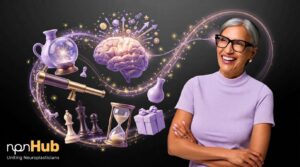


How the brain adapts from childhood to older adulthood through learning, experience, movement, and connection
npnHub Editorial Member: Dr. Justin James Kennedy curated this blog
Key Points
- Neuroplasticity is the brain’s lifelong ability to change its structure, function, and connections in response to experience.
- The young brain is highly plastic, but adult and older brains also retain meaningful capacity for adaptation.
- Different life stages bring different forms of plasticity, from rapid childhood learning to adult refinement and older age compensation.
- Brain regions such as the prefrontal cortex, hippocampus, basal ganglia, and sensory cortices change across the lifespan.
- Lifestyle factors such as movement, sleep, learning, social connection, and stress regulation influence brain health at every age.
- Practitioners can support neuroplasticity by matching interventions to developmental stage, cognitive load, emotional state, and client goals.
1. What is Neuroplasticity Across the Lifespan?
Imagine a neuroscience practitioner working with three clients in one week. The first is a child learning emotional regulation. The second is a midlife professional retraining attention after burnout. The third is an older adult rebuilding confidence after noticing memory changes. Each client is at a different life stage, yet each brain is doing the same remarkable thing: adapting.
This is an illustrative example, not a scientific case.
Neuroplasticity refers to the brain’s ability to reorganize itself by changing neural connections, strengthening useful pathways, weakening unused ones, and adapting to new demands. In childhood, this plasticity is rapid and highly sensitive to experience. In adulthood, it becomes more selective and shaped by attention, repetition, motivation, and meaning. In older age, plasticity may slow, but it does not disappear.
The idea that the adult brain can change is now central to modern neuroscience. Research on neuroplasticity across development and aging describes plasticity as a lifelong process involved in learning, memory, recovery, and adaptation (Mateos-Aparicio & Rodríguez-Moreno, 2019).
For practitioners, the key message is hopeful but realistic. The brain changes at every age, but it does not change in the same way at every age. Effective support depends on understanding what kind of plasticity is most available in each life stage.
2. The Neuroscience of Neuroplasticity Across the Lifespan
Picture an educator teaching a group of adults who believe they are “too old to learn.” Instead of beginning with motivational slogans, she explains that the brain does not stop changing after childhood. It changes differently. The room shifts. Learners begin to see effort not as evidence of decline, but as the brain doing new work.
This is an illustrative example, not a scientific reference.
In early life, the brain builds and prunes connections at high speed. Sensitive periods allow experience to strongly shape sensory, language, emotional, and social circuits. Research on sensitive periods explains that development contains windows of heightened environmental influence, when experience has especially strong effects on brain organization (Gabard-Durnam & McLaughlin, 2020).
In adulthood, plasticity becomes more targeted. The prefrontal cortex supports planning, self-regulation, and goal-directed learning. The hippocampus supports memory and context. The basal ganglia help automate repeated behaviors. The cortex continues refining networks through practice, attention, and feedback.
Older adulthood brings both vulnerability and adaptation. Some brain regions show structural and functional decline, yet the aging brain can compensate by recruiting alternative networks. Reviews on adaptive neuroplasticity and cognitive resilience describe aging as a process that includes decline in some systems but continued reorganization in others (Chauca et al., 2026).
The main brain areas affected include the prefrontal cortex, hippocampus, sensory cortices, motor cortex, basal ganglia, default mode network, and white matter pathways.
3. What Neuroscience Practitioners, Neuroplasticians and Well-being Professionals Should Know About Neuroplasticity Across the Lifespan
A wellbeing professional may work with an older client who says, “It is too late for me to change.” In another session, a younger client may say, “This is just how my brain is wired.” Both clients are expressing different versions of the same myth: that the brain is fixed.
This is an illustrative example, not a scientific case.
Professionals should know that neuroplasticity is not unlimited magic. It is biological adaptability. The brain can change across the lifespan, but change depends on repetition, emotional relevance, sleep, attention, reward, and environment. A child may learn quickly because the brain is highly sensitive to input. An adult may learn deeply when the goal is meaningful and practiced consistently. An older adult may need more time, more repetition, and more recovery, but meaningful change is still possible.
One common misconception is that aging equals inevitable cognitive collapse. Aging can involve slower processing speed or reduced working memory capacity, yet many older adults maintain strong vocabulary, emotional regulation, pattern recognition, and wisdom. Research on cognitive reserve suggests that education, complex activity, and lifelong engagement may help explain why some people tolerate age-related brain changes better than others (Stern, 2012).
Professionals often encounter questions such as:
- Is there an age when neuroplasticity stops?
- Why do children learn faster than adults?
- Can older adults still build new habits, skills, and cognitive resilience?
The answer is that plasticity continues, but the conditions for change become more specific. Practitioners must match interventions to the client’s age, nervous system state, and lived context.
4. How Aging Affects Neuroplasticity
Aging affects neuroplasticity by changing the speed, efficiency, and biological conditions under which the brain adapts. In younger brains, plasticity is broad and often rapid. In adult brains, plasticity becomes more experience dependent. In older brains, plasticity may require stronger support from lifestyle, repetition, emotional safety, and recovery.
The hippocampus is especially important because it supports learning, memory, and context. Adult hippocampal neurogenesis remains an active area of research, and recent reviews describe both its potential importance and the ongoing scientific debate around how it functions in humans (Terreros-Roncal et al., 2021). This matters because practitioners should avoid overstating claims. The aging brain is adaptable, but not every popular statement about “growing new brain cells” is settled science.
White matter also changes with age. These pathways help different brain regions communicate efficiently. As white matter integrity shifts, processing speed and coordination can be affected. Yet the brain can compensate by recruiting broader networks, using strategies, and relying on accumulated knowledge.
Lifestyle is a major influence. A review on exercise, cognition, and brain health in aging explains that physical activity is associated with neuroplastic adaptations and may support cognitive and brain health in older adults (Silva et al., 2024) . This supports a practical message: age changes the brain, but behavior still shapes the trajectory.
Neuroplasticity across the lifespan is not about staying young. It is about helping the brain adapt well at every stage.
5. Neuroscience-Backed Interventions to Support Lifespan Neuroplasticity
Behavioral interventions matter because plasticity is experience dependent. A practitioner may understand that the brain can change, but the client needs the right type of repeated experience for their stage of life. The main challenge is that many people either overestimate plasticity and expect instant transformation, or underestimate it and assume change is impossible. Effective intervention sits between those extremes. It gives the brain enough novelty to adapt, enough repetition to learn, enough safety to engage, and enough meaning to persist.
1. Age-Matched Learning Design
Concept: Sensitive periods make early life especially responsive to environmental input, while adult learning relies more heavily on attention, relevance, practice, and feedback. Gabard-Durnam and McLaughlin describe sensitive periods as windows when experience can strongly shape development (Gabard-Durnam & McLaughlin, 2020).
Example: An educator works with children using movement, play, and sensory learning, while using reflection, goal setting, and applied problem-solving with adults.
Intervention:
- Match the learning method to the client’s developmental stage.
- Use play, sensory input, and repetition with children.
- Use relevance, autonomy, and real-world application with adults.
- Use slower pacing, retrieval practice, and confidence building with older adults.
- Review progress regularly so the client can see evidence of change.
2. Movement to Support Brain Adaptation
Concept: Physical activity supports brain health through multiple mechanisms, including vascular function, neurotrophic factors, inflammation regulation, and network efficiency. Stillman and colleagues review evidence that exercise can support cognition and neuroplastic adaptations in aging (Silva et al., 2024).
Example: A wellbeing practitioner supports a midlife client who feels mentally foggy after chronic stress. Rather than beginning with complex cognitive training, the practitioner introduces consistent walking as a foundation for attention and mood regulation.
Intervention:
- Help the client choose a safe and realistic form of movement.
- Link movement to a specific brain goal, such as focus, mood, or memory.
- Start with short sessions to build consistency.
- Combine movement with reflection or learning when appropriate.
- Encourage medical guidance for clients with health conditions or mobility concerns.
3. Cognitive Reserve Building
Concept: Cognitive reserve refers to the brain’s ability to cope with age-related changes or pathology by using flexible networks and strategies. Stern’s work explains that life experiences such as education, occupational complexity, and mental engagement may contribute to reserve (Stern, 2012).
Example: A coach works with a retired client who fears cognitive decline. Together, they design a weekly routine that includes language learning, social discussion, music practice, and problem-solving tasks.
Intervention:
- Ask the client to choose one mentally engaging skill.
- Make the task challenging but not overwhelming.
- Add social interaction when possible.
- Encourage variety across language, music, memory, creativity, and reasoning.
- Track enjoyment and mastery, not just performance.
4. Sleep and Consolidation Support
Concept: Sleep plays a central role in learning and memory consolidation. Research by Walker and Stickgold explains how sleep supports memory processing and stabilization after learning (Walker & Stickgold, 2004).
Example: A neuroscience practitioner works with a client who practices new emotional regulation skills late at night but sleeps poorly. The practitioner explains that learning does not end when practice ends. Sleep helps the brain consolidate what was practiced.
Intervention:
- Schedule learning or practice at times that do not disrupt sleep.
- Encourage consistent sleep routines where possible.
- Ask clients to review one key learning point before winding down.
- Avoid intense cognitive overload close to bedtime.
- Link sleep to neuroplasticity so clients see rest as part of training.
5. Emotional Safety Before Cognitive Stretch
Concept: Stress affects the brain’s ability to learn and adapt. McEwen’s work on stress and allostatic load explains how chronic stress can affect brain systems involved in memory, emotion, and regulation (McEwen, 2007)
Example: A practitioner works with an adult learner who says they are “bad at learning.” Before introducing difficult tasks, the practitioner helps reduce threat by normalizing mistakes and building a safe practice environment.
Intervention:
- Begin with nervous system regulation before demanding performance.
- Normalize mistakes as part of plasticity.
- Use small challenges instead of sudden overload.
- Track emotional state before and after learning.
- Celebrate effort, strategy, and persistence.
6. Social Connection as a Plasticity Support
Concept: Social engagement supports cognitive and emotional health across aging. Reviews on social isolation and cognition show that social disconnection is associated with poorer cognitive outcomes, while meaningful engagement may support resilience (Evans et al., 2019).
Example: A wellbeing professional works with an older adult who has become socially withdrawn. Instead of focusing only on memory exercises, the practitioner supports group learning, conversation, and shared activities.
Intervention:
- Identify one meaningful social connection goal.
- Pair cognitive activity with social interaction.
- Encourage group learning, discussion, mentoring, or volunteering.
- Use shared routines to improve consistency.
- Notice improvements in mood, confidence, and engagement.
6. Key Takeaways
Neuroplasticity does not belong only to childhood. The brain changes from early development through older adulthood, but the form of change shifts with age. Young brains are highly sensitive to experience. Adult brains adapt through focused practice, relevance, and repetition. Older brains may change more slowly, but they can still reorganize, compensate, and build resilience.
For practitioners, the message is both empowering and responsible. We should never promise instant rewiring, but we should also never tell clients that change is no longer possible.
- Neuroplasticity continues across the lifespan.
- Childhood plasticity is rapid and highly experience sensitive.
- Adult plasticity depends strongly on attention, relevance, motivation, and repetition.
- Older adults can still learn, adapt, and build resilience.
- Movement, sleep, social connection, emotional safety, and cognitive challenge all support brain change.
- The best intervention is age-aware, realistic, repeated, and meaningful.
7. References
- Chauca, J. M. N., Sánchez, M. de J. O., Quintana, N. G., Martín del Campo Márquez, K. L., Carvajal Juarez, B. A., Rojas Mendoza, N., & Aguilar Díaz, M. A. (2026). Neuromarkers of adaptive neuroplasticity and cognitive resilience across aging: A multimodal integrative review. Neurology International. https://pmc.ncbi.nlm.nih.gov/articles/PMC12844308/
- Evans, I. E. M., Martyr, A., Collins, R., Brayne, C., & Clare, L. (2019). Social isolation and cognitive function in later life: A systematic review and meta-analysis. Journal of Alzheimer’s Disease, 70(s1), S119–S144. https://pmc.ncbi.nlm.nih.gov/articles/PMC6700717/
- Gabard-Durnam, L. J., & McLaughlin, K. A. (2020). Sensitive periods in human development: Charting a course for the future. Current Opinion in Behavioral Sciences, 36, 120–128. https://www.sciencedirect.com/science/article/abs/pii/S2352154620301388
- Mateos-Aparicio, P., & Rodríguez-Moreno, A. (2019). The impact of studying brain plasticity. Frontiers in Cellular Neuroscience, 13, 66. https://www.frontiersin.org/journals/cellular-neuroscience/articles/10.3389/fncel.2019.00066/full
- McEwen, B. S. (2007). Physiology and neurobiology of stress and adaptation: Central role of the brain. Physiological Reviews, 87(3), 873–904. https://journals.physiology.org/doi/full/10.1152/physrev.00041.2006
- Stern, Y. (2012). Cognitive reserve in ageing and Alzheimer’s disease. The Lancet Neurology, 11(11), 1006–1012. https://pmc.ncbi.nlm.nih.gov/articles/PMC3507991/
- Silva, N. C. B. S., Barha, C. K., Erickson, K. I., Kramer, A. F., & Liu-Ambrose, T. (2024). Physical exercise, cognition, and brain health in aging. Trends in Neurosciences, 47(6), 402–417. https://www.sciencedirect.com/science/article/pii/S0166223624000626
- Terreros-Roncal, J., Moreno-Jiménez, E. P., Flor-García, M., Rodríguez-Moreno, C. B., Trinchero, M. F., Cafini, F., Rábano, A., & Llorens-Martín, M. (2021). Impact of neurodegenerative diseases on human adult hippocampal neurogenesis. Science, 374(6571), 1106–1113. https://www.science.org/doi/10.1126/science.abl5163
- Walker, M. P., & Stickgold, R. (2004). Sleep-dependent learning and memory consolidation. Neuron, 44(1), 121–133. https://www.sciencedirect.com/science/article/pii/S0896627304005409