
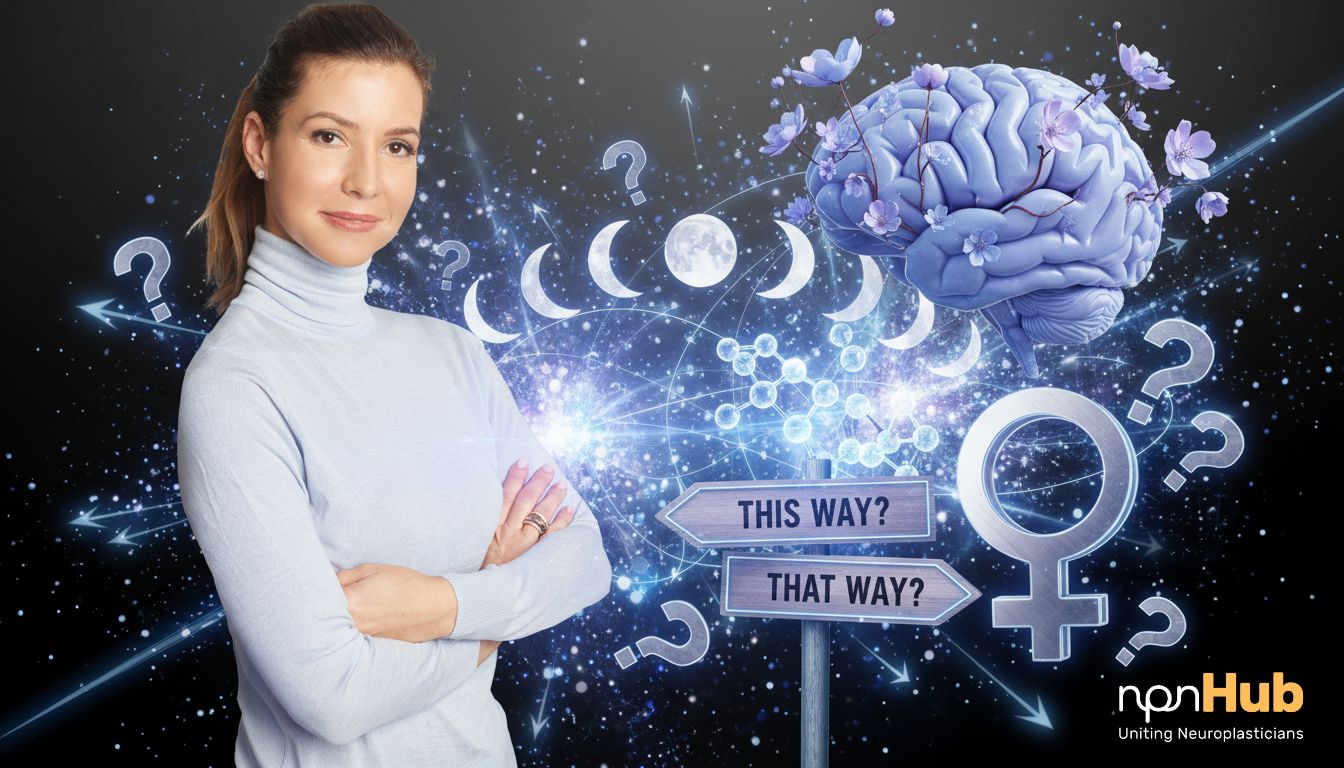
Understanding the Brain–Hormone Connection to Enhance Cognitive Performance, Emotional Intelligence, and Behavioral Outcomes in Women
npnHub Editorial Member: Dr. Justin James Kennedy curated this blog
Key Points
- Hormones such as estrogen and progesterone dynamically influence decision-making processes
- Brain regions like the prefrontal cortex, amygdala, and hippocampus are modulated by hormonal changes
- Female decision-making shifts across cycles, enhancing different cognitive strengths
- Hormonal patterns affect risk, emotion, and social cognition
- Understanding these patterns allows practitioners to personalize interventions effectively
1. What is How Hormones Shape Female Decision-Making?
Imagine a leadership coach working with a senior executive who seems highly decisive and strategic in some sessions, yet more reflective and emotionally attuned in others. Initially, the coach questions consistency. Over time, however, a pattern emerges that aligns with the client’s hormonal cycle.
This is an illustrative example, not a scientific case.
Female decision-making is not fixed. It is biologically dynamic, shaped by fluctuations in hormones such as estrogen and progesterone. These hormonal shifts influence how the brain processes information, evaluates risk, and responds to emotional cues.
Research by Daphna Joel and colleagues demonstrates that the brain does not operate in fixed categories but shifts across states depending on biological and environmental factors (Joel et al., 2015). In women, hormonal cycles play a significant role in these shifts.
Estrogen is often associated with enhanced cognitive flexibility and reward sensitivity, while progesterone supports emotional processing and caution. These changes are not deficits. They are adaptive mechanisms that allow for a broader range of decision-making strategies.
Understanding this reframes variability as intelligence rather than inconsistency.
2. The Neuroscience of How Hormones Shape Female Decision-Making
Consider a neuroscience practitioner running cognitive assessments with a client across several weeks. The client’s attention, emotional sensitivity, and decision speed vary noticeably between sessions. Instead of viewing this as noise, the practitioner maps these changes to hormonal fluctuations.
This is an illustrative example.
At the neural level, hormones act as powerful regulators of brain function. Estrogen enhances activity in the prefrontal cortex, improving working memory, planning, and cognitive flexibility. It also interacts with dopamine pathways, increasing motivation and reward sensitivity (Brinton, 2009).
Progesterone, on the other hand, influences the amygdala, heightening emotional awareness and sensitivity to social cues. This can lead to more cautious, socially attuned decision-making.
Research by Emily Jacobs shows that brain structure itself changes across the menstrual cycle, particularly in the hippocampus and prefrontal cortex (Jacobs et al., 2016).
Neurotransmitters such as dopamine and serotonin fluctuate alongside these hormones, shaping mood, focus, and behavioral responses.
In essence, hormonal activity coordinates a network involving:
- The prefrontal cortex for executive decisions
- The amygdala for emotional evaluation
- The hippocampus for memory integration
3. What Neuroscience Practitioners, Neuroplasticians and Well-being Professionals Should Know About How Hormones Shape Female Decision-Making
A wellbeing practitioner once worked with a group of female entrepreneurs who felt frustrated by what they described as “inconsistent performance.” Some days they felt sharp and decisive, while on others they leaned toward reflection and emotional processing. By introducing education on hormonal rhythms, the practitioner helped reframe these experiences as shifts in cognitive strengths rather than weaknesses.
This is an illustrative example.
A common misconception is that hormonal fluctuations reduce performance. In reality, they redistribute cognitive resources. Research from Harvard Health Publishing highlights how estrogen supports cognitive efficiency and brain health across different contexts (https://www.health.harvard.edu).
Another myth is that emotion interferes with decision-making. In fact, emotional processing enhances social judgment, empathy, and relational decision-making.
Professionals often encounter questions such as:
- How can I adapt coaching strategies without reinforcing gender stereotypes?
- Do hormonal fluctuations impair productivity or enhance different types of thinking?
- How can clients use hormonal awareness to improve decision-making outcomes?
Understanding these dynamics allows practitioners to design flexible, personalized strategies rather than rigid performance expectations.
4. How Hormones Shape Female Decision-Making Affects Neuroplasticity
Hormones play a direct role in shaping neuroplasticity, influencing how neural pathways are formed and strengthened over time. Estrogen, in particular, promotes synaptic growth and increases connectivity in the hippocampus, supporting learning and memory.
Repeated behaviors during specific hormonal phases can reinforce distinct neural circuits. For example, engaging in analytical thinking during high-estrogen phases may strengthen executive networks, while engaging in reflective or socially driven tasks during progesterone-dominant phases may enhance emotional intelligence pathways.
Research by (Woolley and McEwen, 1992) demonstrated that estrogen increases dendritic spine density in the hippocampus, highlighting its role in structural brain plasticity.
Over time, this cyclical reinforcement allows the brain to develop a broader and more flexible repertoire of cognitive and emotional responses. Hormonal variability, therefore, supports adaptability rather than limiting it.
5. Neuroscience-Backed Interventions to Improve How Hormones Shape Female Decision-Making
Behavioral interventions matter because many clients misinterpret natural hormonal shifts as inconsistency or underperformance. A neuroscience coach working with high-achieving women may notice clients trying to maintain constant output, rather than aligning with their brain’s changing optimal states.
1. Cycle-Based Cognitive Alignment
Concept: Estrogen enhances executive function and cognitive flexibility (Brinton, 2009)
Example: A coach helps a client align strategic decision-making tasks with high-focus phases
Intervention:
- Track cognitive and emotional patterns across the cycle
- Schedule high-focus work during peak cognitive phases
- Use lower-energy phases for reflection and planning
- Encourage awareness through journaling
2. Emotional Intelligence Optimization
Concept: Progesterone increases sensitivity to emotional and social cues (Jacobs et al., 2016)
Example: A therapist uses emotionally sensitive periods for deeper interpersonal work
Intervention:
- Guide clients through emotional reflection exercises
- Incorporate relationship-focused coaching sessions
- Practice empathy and perspective-taking
- Reframe emotional shifts as valuable data
3. Dopamine-Based Motivation Structuring
Concept: Hormonal fluctuations influence dopamine and motivation (Dreher et al., 2007)
Example: A practitioner supports clients in maintaining motivation during low-energy phases
Intervention:
- Break goals into smaller, achievable steps
- Reinforce progress with immediate rewards
- Adjust expectations based on energy levels
- Track motivation trends over time
4. Mindfulness for Hormonal Awareness
Concept: Mindfulness strengthens prefrontal regulation and emotional awareness (Lazar et al., 2005)
Example: A wellbeing professional teaches clients to observe internal changes without judgment
Intervention:
- Practice daily body awareness techniques
- Track mood patterns objectively
- Use breathwork during emotional intensity
- Reflect on insights weekly
6. Key Takeaways
Hormones are not obstacles to effective decision-making. They are biological signals that shape how the brain processes information, emotion, and risk. When understood and leveraged correctly, they expand cognitive flexibility and enhance performance.
For practitioners, the opportunity lies in helping clients move from frustration to awareness. Instead of forcing consistency, the goal is to build adaptability and alignment with natural brain rhythms.
- Hormonal fluctuations shape cognition, emotion, and behavior
- Different phases support different strengths, not weaknesses
- Neuroplasticity allows the brain to adapt and optimize over time
- Personalized strategies improve performance and well-being
7. References
- Joel, D. et al. (2015). Sex beyond the genitalia. PNAS. https://www.pnas.org/doi/10.1073/pnas.1509654112
- Brinton, R. D. (2009). Estrogen regulation of cognition. Nature Reviews Neuroscience.https://pmc.ncbi.nlm.nih.gov/articles/PMC3167490/
- Jacobs, E. G. et al. (2016). Impact of Sex and Menopausal Status on Episodic Memory Circuitry in Early Midlife. Nature Communications. https://pubmed.ncbi.nlm.nih.gov/27683911/
- Woolley, C. S., & McEwen, B. S. (1992). Estradiol and hippocampal plasticity. https://pubmed.ncbi.nlm.nih.gov/1613547/
- Dreher, J. C. et al. (2007). Menstrual cycle and reward sensitivity. Journal of Neuroscience. https://pubmed.ncbi.nlm.nih.gov/17267613/
- Lazar, S. W. et al. (2005). Meditation experience is associated with increased cortical thickness.https://pubmed.ncbi.nlm.nih.gov/16272874/